Motorized Patio Screens in Minnesota: A Buyer's Guide to Sentry Retractable Screens
August 14, 2026 · Buying Guide
How motorized Sentry retractable patio screens turn a Minnesota deck or porch into a three-season, bug-free, glare-controlled room. Sizing limits, openness factor by exposure, wind-sensor operation, and when to pair a screen with an awning.
Minnesota's outdoor season is short and it is intense. The mosquitoes show up the week the snow finishes melting, the west-facing evening sun turns a deck into a glare box, and by the time the bugs quit the frost is already back. A fixed screen porch handles one of those problems and gives up on the rest of the year. A motorized retractable patio screen handles all of them and disappears when you want the open view back. After more than 40 years of Sunesta installs across Minnesota and Western Wisconsin, that trade-off is why we point most deck and porch owners at the Sentry screen system first.
What are motorized patio screens?
A motorized patio screen is a mesh fabric screen driven by a tubular motor and controlled by a wireless remote, mounted in a track system that pulls the fabric down flush on both sides to seal an opening. Press one button and the screen lowers in seconds. Press it again and the screen rolls up into a housing at the top of the opening and vanishes. On the Sentry by Sunesta system, the integrated side tracks are what make it work: the fabric locks into channels on each side, so the screen does not billow, gap, or leave the edge gaps that let bugs in on a cheap fixed screen.
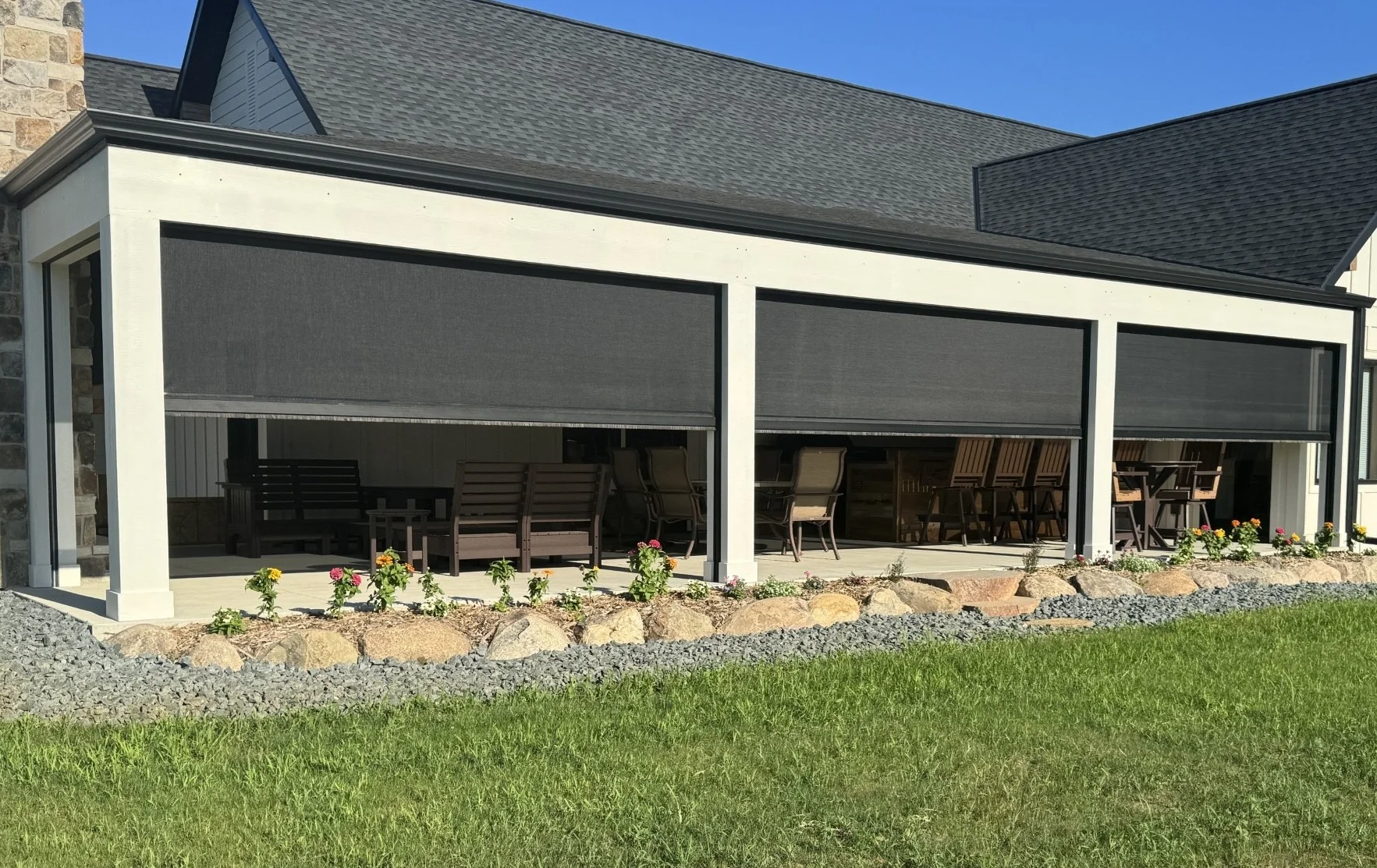
The practical result is a room you can turn on and off. Bugs out, sun knocked down, and a defined space for dinner in July. Then in October, screens up, and you have your open deck back to watch the leaves change. That is the whole pitch, and it is a better fit for our climate than anything permanent.
Retractable patio screens vs. a fixed screen porch
A fixed screen porch is a real structure with a permit, a footing, and a price tag to match. It is also open to the same problem every Minnesota screen porch has: it does exactly one thing, and it does it whether you want it or not. The screen is always there, the view is always filtered, and the wood frame still collects snow and needs paint.
A retractable screen gives you the enclosure on demand instead. A few reasons Minnesota homeowners choose the retractable route:
- The view comes back. Roll the screens up and the opening is completely clear. On a lake home, that matters. A fixed screen never lets you have the unobstructed water view.
- No structural build. The Sentry mounts to an existing deck, porch, or covered patio. There is no permitted three-season-room construction, no footing, no framing crew.
- Winter protection. The screen rolls up into its housing and stays out of the weather. There is no exposed screen fabric to sag, tear, or ice up over the winter.
- One opening or several. A large covered patio can get multiple screens on separate openings, each on its own remote, so you close the windward side and leave the rest open.
We do not market the Sentry as a replacement for a permitted three-season room, and it is not one. What it is: a far more flexible way to get the bug-free, shaded space most people actually wanted from a screen porch in the first place.
How big can a motorized patio screen be?
The Sentry retractable screen covers openings up to 18 feet wide and up to 12 feet tall. That single-unit span handles the large majority of Minnesota deck and covered-patio openings without a center post. For an opening wider than 18 feet, we run two screens side by side, each in its own track and on its own motor, which also gives you the option to close one side and leave the other open. Height up to 12 feet clears most porch headers and second-story deck undersides.
Measure before you dream up the layout. Beams, ceiling fans, light fixtures, sloped headers, and speaker mounts all affect where the housing and tracks land. Our design consultant documents every obstruction during the in-home visit so the housing sits flush and the fabric runs clean top to bottom.
Housing goes at the top of the opening and the tracks run down each side. On a covered patio or porch, that hardware tucks up against the existing structure and reads as part of the build once it is in.
What openness factor should I pick for my patio screen?
Openness factor is the percentage of open weave in the screen fabric, and it is the one spec that decides how the screen actually feels. Lower openness means a tighter weave: more shade, more UV protection, more privacy, and less outward view. Higher openness means a looser weave: more airflow, more visibility, and less sun control. Sentry screen fabrics run roughly a 1% to 14% openness range, and the right pick depends almost entirely on which way the opening faces. Here is how we size it by exposure.
West-facing deck with a lake view
This is the hardest case in Minnesota and the most common one on the water. The low evening sun comes in flat and hot right when you want to be out there, and it is coming from the same direction as the view you paid for. Go low openness, around 1% to 3%. A dense weave in a dark charcoal or bronze tone blocks up to 95% or more of the UV and cuts the glare hard, and because dark fabric reads as a one-way effect in daylight, you still see out toward the water far better than you would through a light fabric. The tight weave is the trade: you keep the view usable during the exact hours that would otherwise chase you inside.
Shaded north-facing porch
A north porch never takes direct summer sun, so glare and UV are barely a factor. Here the job is bugs and a little breeze, not shade. Go higher openness, roughly 10% to 14%. The looser weave keeps airflow moving through the porch and gives you a nearly clear view out, while the sealed track system still keeps the mosquitoes on the other side of the screen. You are buying the enclosure, not the shade, so let the fabric breathe.
East, south, or mixed-use openings
Most decks land in the middle. A south or east exposure gets real sun but not the brutal flat evening angle a west wall does, and plenty of openings pull double duty for both dining and view. A mid-range openness of about 5% to 10% is the popular all-rounder: it knocks down meaningful sun and UV, keeps a usable outward view, and still moves air. When a household cannot decide, this is usually where we land, and it is the most-ordered range for Twin Cities metro decks.
Fabric color matters as much as the number. Charcoal and bronze nearly disappear from inside the space while looking sharp from the street, and they hold outward visibility better than light colors, which also show pollen and dust faster. You can compare the full weave and color options on our screen openness-factor fabrics page, and our consultant brings physical samples to view against your actual siding in daylight.
Motorized operation and the wind sensor
Every Sentry screen is motorized with a wireless remote, and that is not a convenience upgrade in our market so much as the point of the product. A 16-foot screen you have to hand-crank is a screen that stays down when you want the view and stays up when the bugs are out, because nobody wants to fight it. One button solves that.
The controls run three ways, and most people use all of them across a season:
1. Wireless remote. The standard control. One remote runs the screen, and can run multiple screens on a large patio. 2. Wall switch or timer. An optional fixed control near the patio door, handy for a spot where the handheld tends to wander off. 3. Automatic sensors. An optional wind sensor reads wind load in real time and retracts the screen automatically once gusts cross the threshold you set, with no remote and no one home. Sun sensors can automate deployment as well, and the system integrates with major home-automation platforms including Somfy and Z-Wave.
Minnesota note: Our summer storms swing from a calm 90-degree afternoon to 50 mph downburst winds inside an hour. Motorized outdoor screens paired with a wind sensor retract themselves before that gust hits the fabric, which is exactly the failure a homeowner is almost never around to prevent by hand.
When to pair a screen with a retractable awning
A screen and an awning solve different halves of the same problem, and on an uncovered deck you often want both. The awning is the roof: a motorized Sunesta retractable awning throws shade over an open deck in under 60 seconds and pulls back completely when you want full sun. The screen is the walls: it seals the sides against bugs and low-angle sun. Together they turn a bare deck into a shaded, bug-free outdoor room without building anything permanent.
The pairing makes the most sense when:
- Your deck has no existing cover, so there is no porch roof for a screen to hang from. The awning creates the overhead first, and screens can drop from the leading edge.
- You get hot overhead midday sun and low-angle evening glare on the same deck. The awning handles the overhead, the screen handles the flat evening sun, and the two overlap to cover the full day.
- You want the space usable in shoulder season, when an integrated heater under the awning plus screened sides stretches the comfortable evenings that define Minnesota patio life.
Both systems run motorized off wireless remotes, both are American-built in Jacksonville, Florida, and both are backed by the most extensive warranty in the industry. You can see the full screen lineup on our Sentry motorized retractable screens page.
Frequently asked questions
Can you add a retractable screen to a porch?
Yes. The Sentry retractable screen is designed to mount to an existing covered porch, deck, or patio, with the housing at the top of the opening and tracks down each side. There is no permitted structural build involved. As long as there is a sound header to carry the housing and clean vertical runs for the side tracks, most porches are a straightforward install. Our design consultant confirms the mounting surfaces and documents any obstructions during the free in-home visit.
How big can a retractable screen be?
A single Sentry screen covers openings up to 18 feet wide and up to 12 feet tall. For openings wider than 18 feet, we run two screens side by side, each on its own track and motor, which also lets you close one side of a large patio while leaving the other open. Precise width and height at multiple points, measured during the in-home estimate, determine the exact configuration.
Do motorized patio screens keep bugs out?
The Sentry integrated track system pulls the fabric into sealed channels on both sides, which keeps insects and weather out of the enclosed opening. That side-track seal is the difference between a retractable screen and a loose roll-down shade, and it is why the Sentry works as a real bug barrier for a deck or porch rather than just a sun shade.
Which way should my patio screen face for the best sun control?
Sun control depends on the openness factor you choose more than the direction itself, but direction drives the choice. A west-facing opening with hot evening glare wants low openness, roughly 1% to 3%, in a dark tone. A shaded north porch can run high openness, around 10% to 14%, for airflow and view. East, south, and mixed-use openings usually land in the 5% to 10% middle range. We match the fabric to your exposure during the estimate.
Book a free in-home estimate
The fastest way to pick the right screen is to hold the fabric against your own opening and press the button. Our Sunesta Certified Installers bring physical samples, take precise measurements, and match the openness factor to how your deck or porch actually faces, at no charge and no obligation. Call 763-271-3366 to book, or browse our Sentry motorized retractable screens and screen openness-factor fabrics first. We proudly serve Minnesota and Western Wisconsin, and we have been doing it since 1981.